DNV-ST-0378 Padeye Design: A Complete Guide for Offshore Engineers
All five utilisation checks, DAF selection, pin hole tolerancing, and weld throat sizing for DNV-ST-0378 Appendix E padeye design — with worked examples.
Padeyes are among the most safety-critical items on any offshore module, container, or piece of equipment. A lifting lug that fails during a crane pick over the side of a vessel doesn't just lose equipment — it risks lives and triggers regulatory investigations. Yet padeye drawings routinely arrive at yards with missing weld symbols, no material certificates, and no NDT callout.
This guide covers padeye design to DNV-ST-0378 Appendix E — the applicable standard when you're designing a lifting point that will be used in a DNV-classed offshore lift. It covers all five utilisation checks, how to select your DAF, pin hole tolerancing, weld requirements, and the eight things every compliant padeye drawing must include.
1. Scope: When does DNV-ST-0378 apply?
DNV-ST-0378 ("Offshore and platform lifting appliances") governs the design, fabrication, and certification of lifting appliances used in offshore operations. It applies when equipment is lifted on or off offshore installations or vessels in DNV-classed operations.
Appendix E covers padeye design specifically — including SWL marking §E.2, dynamic amplification factor §3.4, pin hole tolerances, weld requirements, and material certificate requirements EN 10204 §3.1.
| Standard | Covers | Applies to |
|---|---|---|
| DNV-ST-0378 App. E | Padeye/lifting lug design on equipment | Equipment being lifted |
| NORSOK R-002 | Lifting equipment system (cranes, slings, rigging) | The crane and sling system making the lift |
| EN 13852-1 | Offshore cranes — general purpose | Crane itself |
2. Appendix E structure — the five checks
Appendix E of DNV-ST-0378 defines five utilisation checks that must all pass (≤ 1.0) for a padeye to be considered structurally adequate:
| # | Check | Clause | Limit |
|---|---|---|---|
| 1 | Pin hole bearing stress | §E.4.2 | ≤ 0.9 × fy |
| 2 | Cheek plate weld throat | §E.4.3 | Minimum throat per weld class |
| 3 | Main plate shear-out area | §E.4.4 | Gross shear area check |
| 4 | Combined stress at hole edge | §E.4.5 | Von Mises ≤ fy |
| 5 | Sling angle factor | §E.3 | Applied to all load calcs |
All five utilisation ratios must be ≤ 1.0. If any one fails, the padeye must be redesigned — typically by increasing plate thickness, enlarging the cheek plates, or increasing weld size.
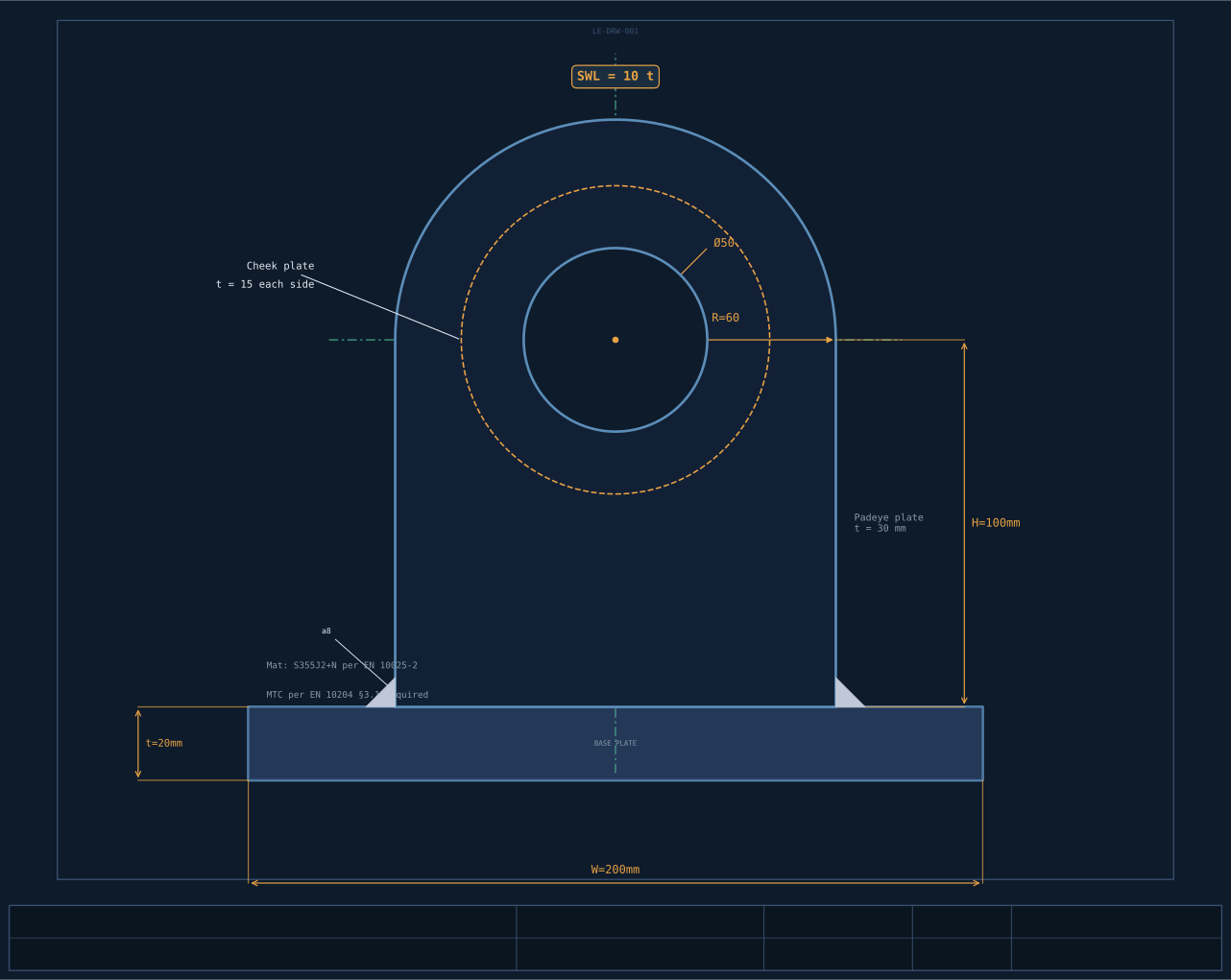
3. Design load: SWL × DAF × sling angle factor
The design load applied to a padeye is not simply the Safe Working Load (SWL). It must account for dynamic effects and sling geometry:
Example: A padeye rated SWL = 10 t, DAF = 1.15, two-leg sling at 60° included angle (θ = 30° from vertical):
The sling angle significantly amplifies the load on each padeye. A four-leg sling at a shallow angle can double the load on each lifting point compared to a vertical lift. Always confirm the sling geometry is defined before finalising padeye sizing.
4. DAF selection guide
The Dynamic Amplification Factor (DAF) accounts for crane acceleration, wave-induced vessel motion, and impact during the lift. The DAF must be stated on the lift plan and traceable to the padeye design.
| DAF | Scenario | Reference |
|---|---|---|
| 1.05 | Crane on fixed platform, calm conditions, shore lift | DNV-ST-0378 §3.4 |
| 1.10 | Moderate offshore lift, stable crane vessel | §3.4 |
| 1.15 | Standard NCS offshore lift, moderate sea state | NORSOK R-002 |
| 1.25 | Heavy lift or lift from floating barge | §3.4 |
| 1.35 | Splash zone lifts, high sea states, no dynamic analysis | §3.4 |
5. The five utilisation checks in detail
Check 1 — Pin hole bearing stress §E.4.2
The pin bears against the hole wall in the main plate (and cheek plates if present). The bearing stress must not exceed 0.9 × the material yield strength fy:
Check 2 — Cheek plate weld throat §E.4.3
When cheek plates are used, the fillet weld between the cheek plate and main plate must be sized to transfer the cheek plate load. The minimum weld throat amin depends on the weld classification per DNV-ST-0378 Table E-1. Full penetration is required when cheek plate thickness exceeds the limit in §E.4.3.
The weld symbol must appear on the drawing per ISO 2553 — both the throat size and weld process. A missing weld symbol on a cheek plate is one of the most common CRITICAL drawing findings.
Check 3 — Main plate shear-out §E.4.4
The gross shear area through the plate on both sides of the pin hole must resist the design load without yielding:
Check 4 — Combined stress at hole edge §E.4.5
The hole edge stress state is biaxial — hoop stress from the pin bearing, plus bending if the load is not perfectly in-plane. DNV-ST-0378 requires a von Mises check at the critical point on the hole periphery:
This check often governs for padeyes with small outer radius-to-hole-radius ratios. The Leide padeye calculator runs all five checks automatically with clause citations.
Check 5 — Sling angle factor §E.3
As described in Section 3 above, the sling angle amplifies the design load. The factor Ksling = 1/cos(θ) must be applied to the SWL×DAF product before any of the four structural checks above. A common error is applying the sling factor only to some checks — it must propagate through all of them.
6. Pin hole tolerancing (ISO 2768)
DNV-ST-0378 requires the pin clearance to be controlled. The shackle bore clearance must be ≤ 6% of the shackle pin diameter (i.e., the pin must fill at least 94% of the bore). Alternatively, the drawing must specify the hole tolerance explicitly.
| Approach | Note |
|---|---|
| ISO 2768-m (medium) | Default general tolerance — acceptable for most padeyes |
| ISO 2768-f (fine) | Use when tight pin fit is critical (e.g. large pin diameters) |
| Explicit tolerance callout | Always preferred for the pin hole — e.g. ⌀60 +0.50 |
7. Weld requirements and NDT
The padeye-to-parent-structure weld is the most safety-critical weld on the assembly. DNV-ST-0378 requires:
- Full penetration weld between padeye main plate and parent structure — verify the weld symbol shows full penetration (butt weld symbol or explicit note "CJP" / "full pen")
- Weld size and process specified — ISO 2553 or AWS A2.4 symbols with throat/leg size
- NDT requirement noted — UT or MT on all padeye-to-structure welds per DNV-ST-0378. This must appear on the drawing, not just in the project specification
- PWHT requirement — required when wall thickness and material grade trigger it (check DNV-ST-0378 Table for thresholds)
8. Material selection and EN 10204 §3.1
DNV-ST-0378 App. E §E.2 requires EN 10204 Type 3.1 (or 3.2) material certificates for padeye plates and cheek plates. A Type 2.2 test report is not sufficient.
| Certificate Type | Content | Accepted for padeyes? |
|---|---|---|
| EN 10204 Type 2.1 | Declaration of conformance only | ❌ No |
| EN 10204 Type 2.2 | Test report — non-specific tests | ❌ No |
| EN 10204 Type 3.1 | Specific inspection cert, manufacturer authorised inspector | ✅ Yes (minimum) |
| EN 10204 Type 3.2 | Specific cert, independent third-party inspector | ✅ Yes |
Grade selection: S355 is the standard structural grade for offshore padeyes. S450 is used where weight is critical. For through-thickness loading (where the design load is applied perpendicular to the plate face — Z-direction), specify through-thickness properties: S355NL-Z35 or equivalent. Missing Z-direction specification on a plate under through-thickness load is a CRITICAL finding.
9. Drawing compliance checklist
A compliant padeye drawing per DNV-ST-0378 App. E must include all of the following. Missing any of items 1–6 typically results in CRITICAL or MAJOR findings:
- SWL — clearly stated in tonnes or kN, positioned prominently on the drawing
- Pin hole diameter with tolerance — explicit callout, not relying on general tolerance only
- Material specification — grade, standard reference, and EN 10204 §3.1 certificate requirement
- Weld throat and symbol — complete weld symbol per ISO 2553 or AWS A2.4, including throat size and process
- Full penetration note — explicit CJP or full penetration callout on padeye-to-structure weld
- NDT requirements — UT or MT, scope and acceptance criteria reference (e.g. ASME V + DNV-ST-0378)
- Cheek plate dimensions — if applicable: thickness, material, weld detail
- Surface treatment — corrosion protection class per NORSOK M-501 or project spec
- Title block — drawing number, revision, scale, approval signature
10. Common CRITICAL findings in padeye drawing reviews
| Finding | Severity | Clause |
|---|---|---|
| Missing EN 10204 §3.1 certificate reference on material note | CRITICAL | §E.2 |
| No NDT requirement specified on drawing | CRITICAL | §E.4.1 |
| No weld symbol on cheek plate-to-main plate connection | CRITICAL | §E.4.3 |
| Through-thickness loading without Z-direction property specified | CRITICAL | §E.2 |
| SWL not stated on drawing | CRITICAL | §E.2 |
| Pin hole with no tolerance callout | MAJOR | §E.4.2 |
| DAF = 1.05 used for offshore crane lift without justification | MAJOR | §3.4 |
| Full penetration not specified on padeye-to-structure weld | MAJOR | §E.4.1 |
Run all five checks automatically
The Leide padeye calculator runs all five DNV-ST-0378 Appendix E utilisation checks — enter your geometry and loads, get clause-cited results instantly. The AI Drawing Checker flags missing weld symbols, incorrect material certs, and NDT omissions on your actual drawings.
More from the Leide blog
- 30 April 2026Welcome to the Leide blog
Engineering articles on DNV, NORSOK, EN, and ISO standards — written for offshore and marine engineers.
- 15 April 2026Bolt Torque Calculator: K-Factor, VDI 2230, and Hydraulic Tensioning
Free bolt torque calculator with VDI 2230 systematic method, K-factor torque, hydraulic tensioning, ASME B16.5 flange presets, and gasket checks. 32 bolt sizes, 15 material grades.
- 15 April 2026Weld Sizing Calculator: Directional Method, Simplified Method, and Weld Group Analysis for Offshore Steel
Free weld sizing calculator for fillet, butt, and partial penetration welds. EN 1993-1-8 directional method, AWS D1.1 strength, weld group analysis, and electrode matching.